
In the world of marine surveying, theoretical knowledge is a valuable asset, but it is the wisdom forged through decades of hands-on craftsmanship that separates a good surveyor from a true expert. To understand the structural integrity, hidden flaws, and idiosyncratic behaviours of a vessel—whether it is a 1930s wooden racing yacht or a modern composite hull—one must first understand exactly how it was built.
For Julian Dyer, that deep understanding began more than forty years ago in the historic heart of British shipbuilding. This is the story of how a young apprentice shipwright immersed himself in the ultimate testing grounds of Portsmouth Dockyard and Camper & Nicholsons, riding the wave of the classic yacht revival to become a specialist in wooden vessel construction, restoration, and comprehensive marine surveying.
Part I: The Portsmouth Crucible (1985–1989)
Anchored in Tradition
In 1985, Julian entered Portsmouth Dockyard as a young shipwright apprentice. The dockyard was a sprawling, industrial landscape echoing with the sounds of heavy machinery, caulking irons, and the distinct, sweet scent of seasoned timber. It was an environment that demanded absolute precision, physical stamina, and a deep respect for the hazards of heavy engineering.
Portsmouth Dockyard (1985) ➔ HMS Victory Renovation (1986) ➔ Apprentice of the Year (1988)
By 1986, Julian’s rapid progression earned him a placement on the prestigious HMS Victory renovation program. Working on Admiral Nelson’s legendary flagship was not a mere history lesson; at times it was a gruelling, masterclass tutorial in massive-scantling wooden shipbuilding.
The Scale of Great Oak
On the Victory, the dimensions of the timber were staggering. Julian found himself working with oak on a large scale, including:
- Futtocks: Replacing the imposing 12” x 12” x 20’ curved frames that formed the vessel’s dense, rib-like internal structure, between the inner and outer planking.
- Planking: Handling and fastening heavy hull planks measuring 6” thick, 12” wide, and up to 30’ long.
- Deck Beams: Replacing heavy deck beams measuring 18” x 18” and stretching 51’ across the ship, usually made in three scarfed sections.
Julian learned to surface-finish these huge timbers using the shipwright’s adze—a traditional, curved swing-blade tool that requires perfect hand-eye coordination. A single misplaced stroke could ruin a precious piece of oak or cause severe personal injury. This work instilled in him an innate understanding of different wood types and their uses for varying applications, timber replacement, and structural load pathways.
Mastering Small Craft and Spars
 Beyond the heavy timber of the Victory, Julian spent several vital months in the historic Boathouse Number 4. Here, the focus shifted from monumental scale to delicate precision.
He built a traditional clinker dinghy under the watchful eye of his mentor to serve as a tender for one of the Dockyard’s Basin Docks. This required selecting quality mahogany planking, shaping it over steam-bent oak timbers and fastening the hull using copper nails and roves—a process known as copper clenching.
Then he learnt the interesting process of constructing tapered spars and yard-arms for HMS Victory from seasoned Douglas Fir. This delicate task required transforming square timber blanks into perfectly aerodynamic, tapered cylinders using a draw knife, hand planes and a keen eye for symmetry.
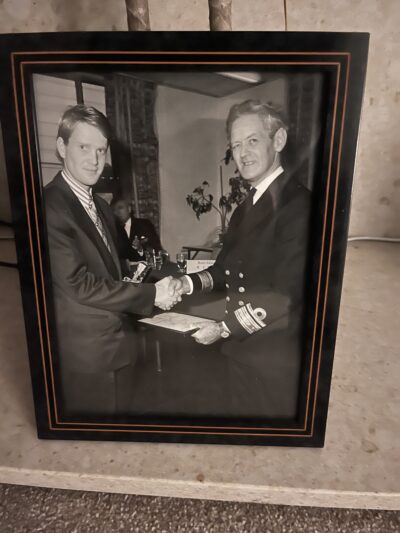
Julian’s exceptional skill, work ethic, and mastery of both heavy and fine woodwork did not go unnoticed. In 1988, he was justly awarded the coveted title of Apprentice Shipwright of the Year.
JULIAN DYER’S APPRENTICESHIP MILESTONES – 1985 to 1992
- 1985 Starts Apprenticeship – first year learning foundation skills to build on
- 1986 Assigned to HMS Victory Renovation
- 1988 Awarded Apprentice Shipwright of the Year
- 1989 City and Guilds Shipbuilding Parts 1, 2 and 3
- 1989 Completes Apprenticeship – Awarded Deeds of Shipwright Craftsmanship Certificate / Warship Duty
- 1992 BTEC Metals Technology including Naval Architecture and Mechanical Engineering Units
A Catalyst for Change
Upon completing his formal apprenticeship in 1989, Julian was promoted to full shipwright status. For safety in the hazardous dockyard environment, he was paired with a veteran shipwright to work on active Royal Navy steel warships.
However, his new partner was also a trade union representative who spent the vast majority of his shifts in the union office. Finding himself sitting idle in a workshop while his active mind craved progression, Julian knew he needed a new challenge. He sought an environment that would test his limits, expand his technical horizons, and satisfy his growing passion for high-performance maritime architecture.
Part II: The Golden Era at Camper & Nicholsons (1990–1991)
Riding the Revival Wave
In 1990, Julian secured a shipwright position at the world-renowned yacht builders, Camper & Nicholsons Yachts in Gosport. He arrived at a pivotal moment in maritime history. During the late 1980s and early 1990s, a trending classic wooden yacht revival was sweeping across the Atlantic from the United States to the United Kingdom. It initially started with a newfound appreciation for historic 12-Metre racing yachts and classic cruiser-racers in the US.
Also during the late 1980s a Swiss business man, Albert Obrist bought and had a famous William Fife & Sons built yacht, Altair completely restored at Southampton Yacht Services. Obrist caught the classic yacht revival bug and set up Fairlie Restorations with Duncan Walker on the river Hamble with the aim to restore as many William Fife yachts as possible. Julian Dyer later became an apprentice trainer (with Vosper Thornycroft) and was happy to place and mentor shipwright apprentices within this great company.
At Camper & Nicholsons, Julian found his true life’s passion: classic wooden yachts that oozed character, history, and unrivalled aesthetic grace.
Larger projects and builds worked on while at Camper and Nicholson Yachts below:- There were many more vessels either in refit or repair.
The Baptism of Fire: 105’ Classic Yacht Moonbeam of Fife
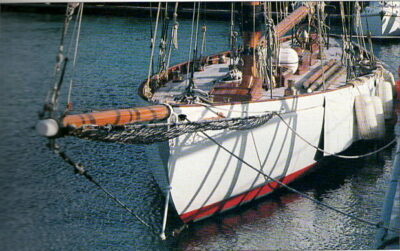 Having cut his teeth on 92’ new build Georgiana, the next challenge for Julian was to be involved with the legendary 1903 William Fife & Sons built cutter, Moonbeam of Fife. While berthed at Ocean Village Marina in Southampton, a devastating gas explosion had ripped through the bilges. The blast was violent enough to blow the vessel’s hatches clean off their fastenings.
With the owner’s agreement, Camper and Nicholson Yachts took this opportunity to address critical areas below the waterline. Julian was tasked with replacing a section of hull planking that was rotten around a depth sounder transducer.
This was a high-stakes repair. The keel sat more than 12 feet below the waterline, meaning the hydrostatic pressure on the hull at that depth was substantial; any structural failure or inadequate caulking would result in catastrophic flooding. Julian executed this planks replacement with precision earning him a specific mention under the heading “Craftsmen” in the May 1991 issue of Classic Boat magazine.
Rebuilding Trivia and Flica 2 – 12m Racing Yachts
Julian was soon integrated into the elite teams tasked with rebuilding two historic 12-Metre racing yachts: 70’ Trivia (built by Camper & Nicholsons in 1937) and 67’ Flica 2 (built by William Fife & Sons in 1939).
The rebuilding of Trivia in 1990 was carried out under the stringent, uncompromising supervision of Lloyd’s Register. Flica 2 arrived for her full restoration just as Trivia was being completed. Once the frames were replaced and the hull was planked, the plank seams were raised and looked like a “three penny bit” in cross section. When flat, rectangular planks meet edge-to-edge over the tight, vertical curves of a yacht’s frames, they form sharp, pronounced ridges running fore and aft. To the untrained eye, the hull looks faceted rather than round.
To cure this, amongst a small team of shipwrights, Julian stood underneath the hull using a cast iron 18″ Jack Plane weighing 4Kgs and planed off these overhead areas for days on end which certainly created legendary boatbuilding stamina, forged into his character through this process. Once the high ridges were planed out, a crew of six men or more used a long length of flexible plastic pipe wrapped in sandpaper to sand the hull in preparation for painting. Using synchronised, diagonal and vertical pushing and pulling motions, they long-boarded the hull. This arduous process eliminated the smallest of imperfections, creating the perfectly streamlined, fair curves necessary for a racing yacht’s mirror-like paint finish.
Touching Greatness: Blue Leopard
During this exceptionally busy tenure, Julian also contributed his skills to another titan of the classic yacht world:-
Blue Leopard: The iconic 111-foot classic motor yacht built by William Osborne & Sons in 1963, known for her advanced lightweight wooden construction and high-performance design. The vessel underwent a refit at Camper and Nicholson Yachts in the late 1990s.
Part III: Diversification and the Rebirth of Hunter’s Moon
Navigating the 1991 Recession
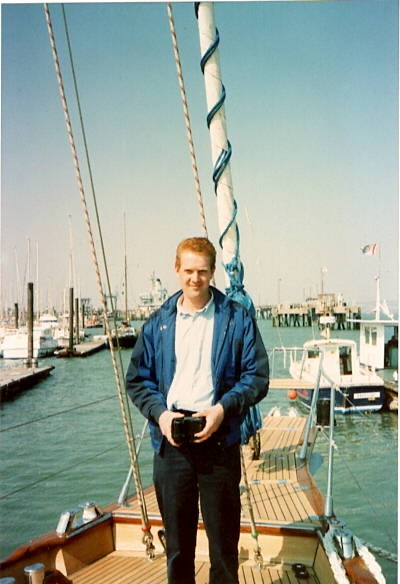 Late in 1991, a severe economic recession hit the UK marine industry. Yacht orders ceased almost overnight, forcing Camper & Nicholsons to lay off the majority of their yard staff. Through recommendation, Julian was asked to survey and sea-trial a wooden yacht with the potential to rebuild by himself.
Hunter’s Moon, was a 23-foot classic wooden yawl originally built in 1953 by the Feltham Brothers at the Camber Docks in Old Portsmouth. The vessel had not received the right treatment by the previous owners and had been kept on a tidal mooring which had caused significant weaknesses throughout the vessel’s hull structure, as it was forced to lay on it’s side at every low tide. Julian was assigned to complete a comprehensive full condition survey report which thankfully did not put off the new owner from proceeding and Julian was commissioned to completely rebuild the yacht with two specific requirements:-
- The restoration work had to be of a very high standard so the vessel would last at least another 25 years before requiring further intervention again (except for the on going maintenance work).
- The owner (like so many classic yacht enthusiasts) wanted to be an active role in the restoration and was thrilled to be part of restoring his own yacht. How could Julian say no and before long, he had a keen and eager apprentice around twice his age. Due to the “apprentice factor” the project did take much longer than a conventional boatyard scenario, but the owner was absolutely delighted on launch day and many years beyond. As part of the rebuild ethos and where appropriate, rather than just replacing like for like, many elements were redesigned to optimise the user experience, the vessel’s structural durability and ultimately what would ensure the lifecycle would be at least another 25 years. 28 years after the restoration work was complete, the yacht is still sailing well today although sadly not with the original owner but now with his son.
Engineering Innovation
Operating out of a private workshop at Thornham Marina, Julian completely rebuilt all aspects of the yacht while sensitively keeping as much of the original vessel as possible (around 20% was saved). Two significant design modifications were engineered to correct inherent post-war design flaws:
- The Propulsion System: The original vessel used an inefficient “quarter drive” system, where the propeller shaft exited through the starboard side of the hull, causing asymmetric steering and vibration. The drive shaft and propellor position were changed to the centreline. This created equal balance and smooth water flow over both sides of the rudder and greatly improved the vessel’s turning capability when under auxiliary power.
- The Rudder Profile: The vessel suffered from poor control, especially at low speeds. The underwater rudder profile was redesigned to a square-edged blade, dramatically reducing water turbulence and improving laminar flow, creating turning authority in tight marinas.
To drill off the deadwood on the centreline for the new shaft, a fellow shipwright assisted with these double handed modifications. He wrote an article in the November 1997 issue of Classic Boat magazine, detailing how these changes were made.
The Ultimate Asset for a Marine Surveyor
Julian Dyer’s journey from a 1985 Portsmouth apprentice to an independent master shipwright provides him with a rare, elite background in the modern marine surveying industry.
While he is widely associated with wooden yacht construction, full restoration, refits, and traditional maintenance, his expertise is by no means limited to timber. Throughout his long career, Julian adapted alongside the evolving marine industry, gaining extensive, practical working knowledge across all major hull materials:
- GRP & Advanced Composites: Practical experience in identi fying osmosis, structural delamination, matrix de-bonding and core degradation in Glass Reinforced Plastic, including high-tech Carbon Fibre and Kevlar layups.
- Metals: A deep understanding of metal plate corrosion, galvanic corrosion, crevice corrosion and weld integrity in both Aluminium and Steel hulls. Non destructive testing (NDT) in the forms of:- Visual inspection, dye penetrant, magnetic particle, ultrasonic and even x-ray or gamma ray
When you hire a marine surveyor, you are paying for their eyes, their analytical mind, and their judgment. A surveyor who has spent years swinging an adze on HMS Victory, flattening 12-Metre racing hulls with a 4-kilogram hand plane, and re-engineering classic drivetrains can see right through a fresh coat of paint. They know exactly where structures fail, where moisture hides, and how a vessel behaves under load.
Julian Dyer does not simply inspect boats; he understands them from the keel up, because he has spent a lifetime building them.
If you are looking to purchase, insure, or restore a vessel, ensure your investment is protected by a surveyor with genuine, time-served shipyard expertise.
To discuss booking a comprehensive structural survey for a classic timber, composite, or metal vessel, please get in touch to outline your vessel’s current location, it’s manufacturer and build year, and the specific type of survey (pre-purchase, insurance, or damage assessment) you require. Let’s ensure your vessel is truly seaworthy – get a quote today